Search This Blog

Monday, October 01, 2018

Who’s Really Accountable For Interoperability Between DOD And The VA On E-health Records System?


“FEDSCOOP”

“The departments of Defense and Veterans Affairs both have billion-dollar modernizations in progress for their electronic health record systems. And they’ve each identified who is accountable for the success of those programs.

But the more important question might be: Who is ultimately accountable for seeing that the EHR systems, when fully developed, work together seamlessly as members of the military retire and becomes veterans?”

________________________________________________________________________

“House lawmakers pressed this point this week during the first hearing held by the Veterans Affairs’ Subcommittee on Technology Modernization. They examined the role of the DOD/VA Interagency Program Office (IPO), stood up in 2008 for the exact purpose of ensuring seamless transfer of records. So far, though, that office has no real authority over the interoperability of the two programs —VA’s EHR Modernization and DOD’s MHS GENESIS, both of which are based on Cerner’s commercial EHR platform.

Lauren Thompson, the head of the office, told lawmakers that despite the intention of the 2008 National Defense Authorization Act to make the IPO the single point of accountability for the interoperability of the two departments’ EHRs, “at this point in time, we make recommendations. We do not have the decision-making authority.” IPO is based within DOD.
According to the law, said Carol Harris, director of IT management issues for the Government Accountability Office, “the IPO is supposed to be the single point of accountability. So that would include responsibility, authority and decision-making responsibilities. I think that [the office’s current operation, as described by Thompson], is in conflict with the expectation set out by law.”

The departments and the IPO are trying to sort out the interoperability governance now that VA and DOD each has a massive EHR in development. Though they both are developing instances of the same Cerner platform so that interoperability will be easier to achieve, there are still myriad technical and functional decisions that must align so that the data ultimately matches as it flows from one system to the next. VA, DOD and the IPO are in the process of developing new governance bodies and a new structure with the hope that things can be dealt with at the lowest level possible.

“Clinicians talking to clinicians, technicians talking to technicians,” said John Windom, VA’s acting chief health information officer and program executive officer for the new Office of Electronic Health Record Modernization. When disagreements happen, the issues are elevated to new governance boards, but the goal is to avoid that, he said.

Windom explained that the governance process is “evolving,” and it will take time to get there. “The as-is state of the enterprise with the VA is different than the as-is state of the enterprise within DOD. … Now we’re understanding the gaps between how we sought to implement and how DOD is implementing. And so those gaps have to be reconciled, and they have to be reconciled through governance.”

But even with that model, lawmakers were unhappy because there is no single person or organization accountable. “There’s really no one there to break the ties or resolve the differences,” Rep. Scott Peters, D-Calif., said, pushing for action from the president or Congress to spark the change. “The only person both agencies report to now is the president of the United States.”

Rep. Mike Coffman, R-Colo., said perhaps there’s a place for the IPO in the process, but either the DOD or VA should be given the ultimate decision-making authority.

Harris agreed that a “single executive-level entity that is the point of accountability” with decision-making authority and that binds both departments at the deputy secretary level or higher is “essential.”

She doesn’t have much faith in the IPO, though, at least in its current form — and really for no fault of its own.

“They never had to clout to mediate and resolve issues between DOD and VA,” Harris said. “The IPO was never set up to succeed there because neither of the departments were willing to relinquish control.”

Harris called the IPO’s ability to drive the necessary interoperability “lackluster” in the past decade. “In the past situations, what we’ve seen historically is that when everyone is responsible, no one is responsible. I think that’s what has led us to where we are today,” she said. “Accountability has been so diffused so that when the wheels fall off the bus, you can’t point to a single entity who’s responsible. And that’s a problem.”

https://www.fedscoop.com/dod-va-ehr-interoperability-hearing/

Saturday, September 01, 2018

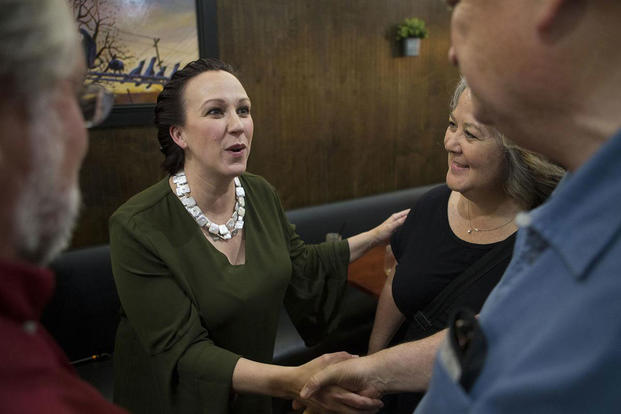
MJ Hegar Sued the Pentagon and Won. Now She's Running for Congress

"Shoot Like a Girl"  and "Doors" Pilot MJ Hegar
MILITARY.COM"
Hegar was one of four female veterans who signed on to a lawsuit, filed in U.S. District Court in 2012 against then-Defense Secretary Leon Panetta. Panetta reversed the combat ban in for women in January 2013. 

She earned the Purple Heart and the Distinguished Flying Cross with "V" device for her actions, which helped save the lives of those aboard her helicopter.   Running as a Democrat against John Carter, an eight-term Republican, she won the democratic primary runoff in May."

"In a powerful campaign video, "Doors," that debuted in June and quickly went viral, Hegar showed the world her story of surviving childhood domestic abuse and the negative effects of gender inequality in her military career. As the ad shows, she'd go on to make her mark on history despite it all.


"We need a new freshman class of servant leaders who are used to working with people we disagree with," Hegar said in a telephone interview with Military.com on Monday.

Hegar, an Air Force and combat veteran, believes her prior service aligns with the type of leadership the U.S. needs at a time of "hyper-partisan" politics that affects the way Americans deal, interact and empathize with one another. Her new mission is to work with her prospective lawmaker colleagues to back a stable, national security environment while fighting for better jobs and medical care back home.

"I see an uncomfortably flippant attitude toward putting our men and women in uniform at risk, by how we treat our allies, or how we treat a nuclear power or how we treat countries that are actively attacking our democracy. I think there are a lot of things that we need a lot more veterans in Congress because of that," she said.

Carter, she said, once denied her a meeting years ago when she was looking for congressional support to pressure the Pentagon to allow women to serve in combat.
Hegar was one of four female veterans who signed on to a lawsuit, filed in U.S. District Court in 2012 against then-Defense Secretary Leon Panetta, calling existing restrictions against women serving in ground combat units unconstitutional. Resolution ultimately did not come through the courts -- the case remains open. But amid mounting pressure, Panetta reversed the ban in January 2013, paving the way for women to serve in previously closed units.

It is one of the reasons she wanted to put her story out there. Eventually, she said, it became the motivation behind her current campaign.

"In the military, we are thrown into a melting pot of cultures and communities and we disagree a lot on how to accomplish the mission, but when it comes time to get the work done, we focus our energy on accomplishing the mission," Hegar said. "We've got to tell our stories to influence culture, and we have to get more people elected who have faced challenges like domestic violence, working minimum-wage jobs, wondering how to get food on the table ... regular people."

OPENING 'DOORS'

Hegar describes herself a private, introverted person who doesn't seek attention. But she says she's concerned about the inadequate representation she's seen throughout her life as a service member, mother and proud Texan.

The "train had already left the station" for getting pretty personal during her powerful commercial, she said.

"Doors" had garnered more than 5 million combined views on YouTube and Facebook as of Tuesday, and in recent weeks has grabbed the attention of fellow veterans, lawmakers and even celebrities.

In the video, Hegar walks viewers through her life: Dreaming, as a young girl, of flying for the Air Force, to lobbying lawmakers to reverse outdated policies, to moments of pain that shaped her life story.

It "was very out-of-character for me, especially with anything to do with my kids [in the public eye] … but this is really who I am," said Hegar, who partnered with Putnam Partners, a political advertising firm, for the commercial.

"This district that I grew up in is a part of who I am, and I love my home, and I feel we deserve better representation," she said.

She won the primary runoff in May. She goes up against Carter in November.
"I got so sick of hearing, 'This is a state this or this is a state that, or I don't have to have a campaign or town hall' " to deal with issues, Hegar said. "If we elect people who have never been to public school, never had to worry about counting on Social Security, then how can they effectively legislate?"

WOMEN AS WARRIORS

Hegar served in the U.S. Air Force first as an aircraft maintenance mechanic working on F-16 Fighting Falcons and then B-2 Spirit bombers between 2000 and 2004.
Her memoir, "Shoot Like a Girl," which contains the occasional F-bomb, was published last year.

"There were very personal, private things like the domestic violence in my life," among other challenges, she said.

"I got this question once where someone asked me, 'How do you resolve the conflict of your warrior heart and your mothering, nurturing nature?' And it's the same thing. I don't know why the American culture separates the two for some reason, when in other cultures throughout history, women have been utilized in various military roles," she added.


MJ Hegar appears in uniform in this undated Air Force service photo.
Hegar experienced sexual assault in the Air Force. Her commanding officer helped her file the paperwork in order to deal with the crime internally, but justice never came. It was one of the reasons she left active duty when an opportunity to fly HH-60 Pave Hawks in the Air National Guard opened up in 2004.

On her third tour in Afghanistan in 2009, Hegar, co-piloting a helicopter during a combat search-and-rescue operation, came under direct enemy fire from the Taliban outside Kandahar.

She was shot, but hung on as the helicopter went down a few miles away. Two Army helicopters rescued the downed crew. Hegar returned fire as they circled over 150 Taliban fighters below. She earned the Purple Heart and the Distinguished Flying Cross with "V" device for her actions, which helped save the lives of those aboard her helicopter.
"I feel like everyone always focuses on the shootdown," she said. "Being a pilot was a lot of hard work … and I had to demonstrate a skill set that I think will come in handy in D.C. and that was … to study and be an expert on a multitude of systems and things like that."

Hegar spent the first half of her career as an aircraft maintenance officer, an experience she said helped her develop management and business leadership skills.

"That's definitely more of the experience I lean on," she said.

Hegar served 12 years before separating as a major. Now, she wants those who exemplify "exceptional fortitude and courage under pressure" and "an inability to accept intimidation and bullying" to step up in Congress.

"The people who are sending our men and women in uniform into conflict need to understand that there are some things worth fighting for, but also understand the high cost of war," she said.

CATALYST FOR CHANGE

Regarding the 2012 lawsuit, filed with the aid of the American Civil Liberties Union, Hegar said her primary concern was for military effectiveness and the impact the exclusion policy had on recruiting and retention.

"We were losing women like myself because those women couldn't move on to jobs that were a natural progression or a natural fit for their skill set because they were women. Which was ridiculous," Hegar said, calling the lawsuit an extra boost to amplify the needed change.

"I was trying to provide a catalyst for change," she said, to "help push the administration over toward the other side of the fence to go ahead and take the very monumental and historic steps to actually repeal the policy."

Hegar helped co-found the Women in International Security's Combat Integration Initiative, a program that supports connecting female veterans through partnerships, conducts independent research to provide lawmakers, and meets with them or their staffers.
"I hate talking about women as a group -- I hate talking about any group as a group, because there are unique attributes to each individual, and that was really my whole argument for opening jobs and competition for women," she said. It should be about, "Let the best soldier win."

Hegar was supposed to sit down with Carter in 2013 to discuss these ideas, but he never showed up, she said. Carter has denied this account.

Hegar said she realized in the end that Carter's no-show wasn't just about trying to repeal one policy. It meant that better representation was needed across the U.S.

STOPPING THE DIVIDE

Over the next few weeks, Hegar anticipates more town halls with community members and door-to-door visits with potential constituents.
It means "there's a real race on our hands," not just going to the ballot box and checking a name of someone district voters wouldn't know, she said.

"I'm doing my part to show the district that we deserve present representation who will listen to the different communities ... and not just stay in D.C. the whole time, but actually stay in the district, talking to and helping people in this district. Helping bring jobs here, helping people bring opportunity here."


MJ Hegar is running against Republican incumbent John Carter in Texas’ 31st Congressional District. After winning her primary in May, Hegar will face off against Carter in the November general election. Courtesy MJ Hegar’s campaign
Hegar is running against Republican incumbent John Carter in Texas' 31st Congressional District. Courtesy MJ Hegar's campaign
She continued, "I think this toxic, hyper-partisanship is part of a gridlock that keeps us from getting anything done in D.C. It disgusts people and makes them tune out, turn off their TVs and stop reading the news. And that's dangerous."

https://www.military.com/daily-news/2018/08/08/mj-hegar-sued-pentagon-and-won-now-shes-running-congress.html


Saturday, August 25, 2018

The Management of Our Leaders Must Come From Within the American People

Photo Credit: (Taken from a magnetized seal on the door of an F-150 Truck in Hastings, MN - driver would not disclose where he acquired it).

Geopolitical expert, George Friedman at STRATFOR and Columnist Aaron David Miller have maintained that the office of the American Presidency is designed to disappoint and that the time of great US Presidents is past. 

Friedman:

“Each candidate must promise things that are beyond his power to deliver. No candidate could expect to be elected by emphasizing how little power the office actually has and how voters should therefore expect little from him. So candidates promise great, transformative programs. What the winner actually can deliver depends upon what other institutions, nations and reality will allow him.”


Miller:

"Greatness in the presidency is too rare to be relevant in our modern times and - driven as it is in our political system by big crisis - too risky and dangerous to be desirable. Our continued search for idealized presidents raises our expectations and theirs, skews presidential performance, and leads to an impossible standard that can only frustrate and disappoint. To sum up: We can no longer have a truly great president, we seldom need one, and, as irrational as it sounds, we may not want one, either." 

 PUTTING THE CITIZEN BACK IN GOVERNMENT

As we approach the National Mid Term Elections we must examine the true strength that springs from our form of government. That strength is in each of us. It simply needs to be projected in managing our leaders.  We must manage our government by becoming involved, conveying to our officials what we individually value and making sure they understand our views continually, not just during an election season.


Technology has made the above objective easier more communicative and effective.

It is not only our vote that is golden but our opinion via surveys and direct input to our government as well. Collectively we must replace the lobbyist, the Super PAC and the stagnated political process by getting through to the pols with focused precision. Social networking, pressure via the collective use of email, public meetings, the press and the media is possible on an individual basis. It is a  matter of becoming motivated to use what is ours and what we pay for with our taxes.

BECOMING OUR OWN MEDIA SOUND BITE, LOBBY AND "IPAC" (INDIVIDUAL PERSON POLITICAL ACTION COMMITTEE)

It is generally accepted that money drives politics. We must change that outlook by putting ourselves as individuals in the driver seat, tuning out the ludicrous media ads, pulling out our bull horns and expressing how we feel. Where others speak with their money we must convey our values with technology, persistence and management.

Let's examine our daily life, our hopes for the future for ourselves and our families and succinctly provide guidance to those who represent us – locally, at the state level and particularly in Washington.


Letters to the editor, blogging, social networking, and physical visits to town hall meetings, representative's offices and similar individual activities exercise strength and grow robust participation. Collectively, the rest of the presently stagnated structure will follow our lead. 

If we believe we need training in communication we must get it, practice and nurture it. If we know someone who is good at oral and written conveyances we must team with he or she and "Bull Horn" the views we personally believe must be addressed. 

In an election year and throughout the year we cannot say we have not the time. We must take the time to exercise our rights or others will sell them. 


Wednesday, August 01, 2018

Foreign Governments Receiving Obsolete Export F-35s Until 2023


Standard
F-35-Money-4-copy AR15 dot com
Click on Image or Download to Enlarge
DEFENSE-AEROSPACE.COM
“Three-quarters of all the F-35 Joint Strike Fighters delivered to foreign customers until 2023 are [or will be] obsolete and will require major retrofits before they can deliver their promised performance.  
[10] Foreign “partners,” [See table] who have already paid a portion of the F-35’s development costs as well as paying for their own aircraft, will realize that they have been abused by Lockheed and the Pentagon.”
___________________________________________________________________________________________
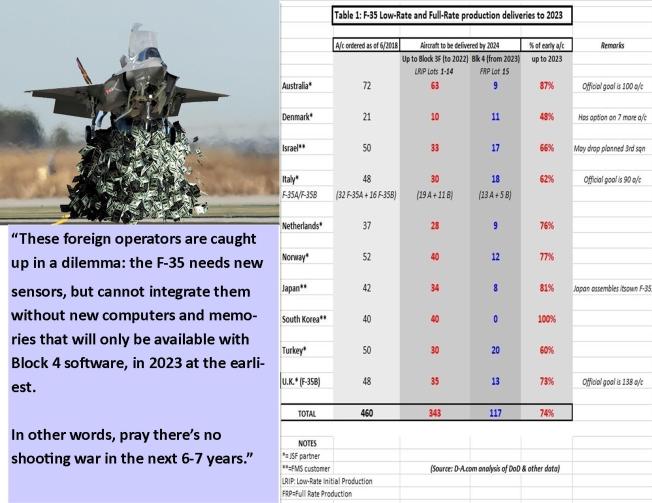
“An analysis of F-35 contracts awarded to date shows that fully 343 – or 74% — of the 460 export F-35s that Lockheed is to deliver until end 2024 will be in the current, obsolete Low-Rate Initial Production configuration.
These 343 aircraft are limited both in terms of operational capabilities and of the weapons they can use. They are, and will remain, obsolete because their software is incomplete and because their sensors – designed over 20 years ago – have been overtaken by several generations electronics progress.
Lockheed and the F-35 Joint Program Office have quietly decided that all of the planned sensor and avionics upgrades needed to bring the F-35 to full capability will be deferred until 2023, when the first Full-Rate Production (FRP) aircraft (Lot 15) will begin to roll off the production lines.
All this, however, is a best-case scenario, and assumes that the F-35 will pass its Initial Operational Test & Evaluation (IOT&E). Due to be completed in 2019 or 2020, IOT&E will allow the Pentagon to take the (Milestone C) decision to launch Full-Rate Production (FRP).
If it doesn’t – and the GAO reported on June 5 that “As of January 2018, the F-35 program had 966 open deficiencies, of which 111 category 1 (critical)” – then all bets are off, and the program will have to undergo a major restructuring.
Fully-capable F-35 only after 2023
Aircraft of the first Full-Rate Production batch (Lot 15) will be the first to benefit from the new package of sensors, electronics and software bringing them to full capability, and which will notably include:
— a new TR-3 (Technology Refresh 3) computer supplied by Harris Corporation that is key to allowing integration of the new capabilities planned for the Block 4 standard. This will include computing infrastructure for new panoramic cockpit displays, advanced memory systems and navigation technology, according to Brad Truesdell, Harris Corp.’s senior director of aviation systems.
— Raytheon’s new Electro-Optical Distributed Aperture System, which Lockheed announced June 13 would replace Northrop Grumman’s current AN/AAQ-37.
— a new Advanced Electro-Optical Targeting System (EOTS) to replace the current system, also made by Lockheed. The company says the current EOTS meets all the contractual specifications, but that the new system – which offers a significant increase in terms of target recognition and detection capability – “would be a further upgrade option purchased at the discretion of the DOD and international F-35 partners and customers,” Lockheed told FlightGlobal at the time.
— a new Panoramic Cockpit Display System (PCDS) made by Elbit Systems of America. In June 2017, Elbit announced a contract from Lockheed Martin to develop a panoramic cockpit display unit to replace the current one, made by L3 Aviation Products.
These new sensors are crucial for the F-35 to achieve the capabilities it was designed to deliver, but which are still not available today, after 17 years of development. Lockheed says, for example, that the new DAS will have five times the reliability and twice the performance of the current system, despite being 45% cheaper to buy and 50% cheaper to operate.
However, Lot 15 deliveries will only begin in early 2023 and, meanwhile, deliveries will continue with the current electronics and sensors.
The US services will also receive obsolete aircraft, but their problem is less severe because they all operate other kinds of combat aircraft, and because they already have indicated they may use the early aircraft for flight-training or as spare parts banks if the cost of upgrading them to Block 4 standard is too expensive.
This is not an option for export customers, however, as for several – notably Denmark, Norway, the Netherlands — the F-35 will be the only combat aircraft, while for all others it is the primary strike aircraft.
Allies to receive obsolete aircraft until 2022
Until 2023, all the Low-Rate Initial Production (LRIP) aircraft ordered by the program’s foreign partners (Australia, Denmark, Italy, Netherlands, Norway, Turkey and the United Kingdom) and Foreign Military Sales customers (Israel, Japan and South Korea) will be delivered in the current configuration.
Click on Image or Download to Enlarge
They will require substantial — and expensive — upgrades to bring them up to the latest Block 4 standard, after the new sensors and electronics become available in 2023.
The cost of developing and implementing the Block 4 configuration is as yet unknown, and figures have been quoted of between $3.9 billion and as much as $16.4 billion.
In any case, it is high enough that the F-35 Program Executive Officer, Vice Admiral Mat Winter, “said his office is exploring the option of leaving 108 aircraft in their current state because the funds to upgrade them to the fully combat-capable configuration would threaten the Air Force’s plans to ramp up production in the coming years,” according to an October 2017 report by the Project On Government Oversight (POGO)
To our knowledge, European operators of the F-35 also have “overlooked” mentioning the cost of upgrading their older aircraft to Block 4 standard when reporting to their respective Parliaments, to which they will now have to go cap-in-hand to request the necessary funds. One can imagine the welcome they will receive from their lawmakers.
And Block 4 is non-negotiable because unless upgraded, all F-35s delivered before 2023 will be severely limited in their capabilities and will only be able to use very few weapons.
Lockheed is currently delivering aircraft with the latest Block 3F software, the first “combat-capable” standard. Block 3F should (but maybe will not) be retrofitted to earlier aircraft. Block 3F allows the use of the Small Diameter Bomb, Joint Direct Attack Munition (JDAM) and the AIM-9X short-range air-to-air missile, in addition to the Advanced Medium Range Air-to-Air Missile (AMRAAM), Advanced Short-Range Air-to-Air Missile (ASRAAM) and various kinds of laser-guided bombs used with earlier software.
Only Block 4 allows most capable weapons – after 2023 
But only Block 4 will allow the F-35 to use the most capable air-to-air missile in the Western inventory – MBDA’s Meteor – as well as two new long-range missiles being developed specifically for the F-35: the Joint Strike Missile (made by Kongsberg, Norway) and the SOM-J air-launched cruise missile (Roketsan, Turkey) as well as the Small Diameter Bomb II and other cutting-edge weapons to come.
If 74% of all export F-35s will be obsolete when delivered, some export customers will receive an even higher proportion: Australia will receive 63 of its 72 aircraft (87%) in LRIP configuration, while the proportion of LRIP aircraft will attain 100% for South Korea, 81% for Japan and 77% for Norway. (see Table 1 above).
Foreign operators will receive a few of the state-of-the-art Lot 15/Block 4 aircraft after 2023, except for South Korea, whose deliveries will be completed in 2021. Quantities will be limited, however, as for example Norway will receive only 12 Block 4 aircraft out of 52, and Australia only 9 out of 72.
These foreign operators are caught up in a dilemma: the F-35 needs new sensors, but cannot integrate them without new computers and memories that will only be available with Block 4 software, in 2023 at the earliest.
In other words, pray there’s no shooting war in the next 6-7 years.
Assuming they do decide to retrofit Block 4 improvements, export customers will have to pay for it themselves, on top of acquisition and post-delivery upgrade costs.
This is when foreign “partners,” who have already paid a portion of the F-35’s development costs as well as paying for their own aircraft, will realize that they have been abused by Lockheed and the Pentagon who, in their rush to produce as many F-35s as fast as possible, have delivered “fifth-generation” aircraft that do not meet contractual performance and cannot match the capability of “legacy” aircraft like Typhoon, and the latest F-15 and F-16s.”

Tuesday, June 05, 2018

2018 Washington Technology Top 100 Defense Contractor Rankings Highlight A Growing Market

PLEASE CLICK ON IMAGE OR DOWNLOAD TO ENLARGE
"WASHINGTON TECHNOLOGY"

"The annual Washington Technology Top 100 ranks the largest government contractors in the market based on their prime contracts. 

The aggregate value of the prime contracts won by the Top 100 companies reached $105.3 billion this y ear, compared to $101.9 billion last year.  And with a two-year budget framework in place, the expectation is that the market will continue to grow for at least that period."
______________________________________________________


"For the second year in a row, a new company holds the No. 1 spot on the annual Washington Technology Top 100.

Last year, Leidos unseated Lockheed Martin after a 22-year run. But this year, Leidos is pushed aside by General Dynamics with Leidos dropping one position to No. 2.
The rise of both Leidos and GD in the rankings is thanks in large part to transformational acquisitions the companies completed. Leidos acquired Lockheed Martin’s IT business in 2016. And GD acquired CSRA earlier this year.
But those deals are about more than just the companies involved. They point toward a market that is undergoing a fundamental change.

The annual Washington Technology Top 100 ranks the largest government contractors in the market based on their prime contracts. We analyze data from the Federal Procurement Data System to identify the top companies providing IT, telecommunications, systems integration and professional services to federal agencies.

You can look up and down the 2018 list and see signs of changes in the market. The M and A activity is the most obvious signs. Besides General Dynamics' acquisition of CSRA, there are other significant deals.

One to watch going forward is the three-way merger of Vencore, KeyPoint Government Solutions and the U.S. public sector business of DXC Technology. The new entity now known as "Perspecta" came in at the No. 9 spot with nearly $3 billion in prime contracts.

Other new entrants to the Top 100 also are the result of deal making such as Peraton at No. 34 with $740.3 million in prime contracts and NTT Data at No. 58 with $349.8 million in prime contracts.

Both companies were created via divestitures by other Top 100 companies. Peraton is the former IT services arm of Harris Corp. and NTT Data acquired Dell’s services business.

The Top 100 also shows some of the emerging tech and business trends in the market.

In recent years we’ve seen the emergence of several companies focused on the space market. Last year, SpaceX made its debut at No. 54 and this year it has come in at No. 46 with $482.1 million in prime contracts.

Northrop Grumman is at No. 3 with $6.7 billion in prime contracts. They are in the process of acquiring Orbital ATK at No. 79 with $251.5 million in prime contracts. If that deal had closed in time, Northrop very likely would have been ranked No. 2.

Executives from companies such as CACI International (No. 10), and Science Applications International Corp. (No. 9) said space is among one of several growing areas for contractors. And we’ve seen several other companies move into the space market and adjacent areas such as Parsons Corp.’s recent takeover of Polaris Alpha. Parsons is ranked No. 50.

Other priority areas include electronic warfare, unmanned systems, data analytics, machine learning, cloud and IT modernization. There also is strong demand for DevOps and Agile application development capabilities.
Some of these are already well established but others are just emerging but carry great promise.

For example, Booz Allen Hamilton (No. 7) is investing in machine learning because executives see it as a game changer for government agencies.
“We are seeing a lot of energy in our client base around an eagerness to learn more and do some piloting around how to apply that technology,” said Gary Labovich, a Booz Allen executive vice president.

And of course, cybersecurity rides as a layer over all of these areas and is a core offering for many companies.

For example, Unisys (No. 41) has developed the Stealth product, which is built on a micro segmentation software platform and mitigates the risk of a hackers by reducing the surface area they can attack.

Unisys’s development of the Stealth product is just one example of how many Top 100 companies investing in the development of solutions and reducing their reliance on just providing services to their customers.

“Our whole story line is we’re moving from being completely reliant on services to balancing our portfolio with solutions,” said CACI CEO Ken Asbury.
Companies on the Top 100 also are becoming more aggressive and increasing the pace at which they submit proposals.

Part of this is because more dollars are flowing so more customers are creating opportunities. At the same time, the trend toward IT modernization and the adoption of new ways of managing IT such as the cloud also are creating opportunities for companies.

Agencies also have moved away from low price, technically acceptable contracts. Executives also are heartened by a trend toward more industry engagement as evidenced by the use of Other Transaction Authorities and activities by organizations such as the Defense Innovation Unit Experimental. These new ways of doing business are driving innovation and the adoption of new technologies.

“I’d like to see it continue in that direction,” said George Wilson, president of ECS Federal (No. 47). “That’s the area we’re focusing all of our attention. We’ve moved away from the lower-end commoditized services and we’ve moved more and more into delivering advanced capabilities.”

Many of the executives reported a rebound in the market and the Top 100 itself validates that believe.

The aggregate value of the prime contracts won by the Top 100 companies reached $105.3 billion this y ear, compared to $101.9 billion last year.
That is two years of back to back growth in the market following five years where the market shrunk.

And with a two-year budget framework in place, the expectation is that the market will continue to grow for at least that period.

“The entire industry gets an opportunity to put sequestration in the rearview mirror for a while, at least for a couple years, and build the capabilities and solutions that have been put to the side,” Asbury said."

https://washingtontechnology.com/articles/2018/06/03/2018-top-100-overview.aspx?s=wtdaily_040618

Monday, March 05, 2018

The 2001 911 (AUMF) - Dying For Reasons American Soldiers and Citizens No Longer Understand


"THE PROJECT ON GOVERNMENT OVERSIGHT"


"Lt. Col. Davis was deployed into combat zones four times in his career, beginning with Operation Desert Storm in 1991, and then to Iraq in 2009 and Afghanistan twice (2005, 2011).

His testimony about the need for Congress to have the integrity to do their job and vote on our current wars is compelling, and I hope you’ll watch it in full [ 7 Minute] video  below."


"Congress’s failure to debate and vote on our current wars has led to a total abdication of its duties to declare war. As a result, many Americans are unclear about our objectives, and the 2001 authorization following 9/11 has been used to justify military operations in 14 different countries at least 37 times. 

Questions surrounding U.S. actions in Yemen—currently being challenged in Congress by Senators Mike Lee (R-UT), Bernie Sanders (I-VT), and Chris Murphy (D-CT)—are raising additional questions about how the White House and the Department of Defense are using that authorization for endless war. “The blank check just got bigger,” Center for Defense Information Military Advisory Board Member and Defense Priorities Senior Fellow Lt. Col. Daniel Davis, USA (Ret.) recently told Members of Congress.

Leadership in both parties have continually resisted calls to hold a vote on our current wars. The Senate Foreign Relations Committee held a hearing on the need to revise the authority for our current wars—known as the Authorization for the Use of Military Force (AUMF)—last year, but there’s been no similar debate in House. So for the first time that I can remember the Progressive Caucus and the Liberty Caucus, led by Representatives Barbara Lee (D-CA) and Justin Amash (R-MI) respectively, held a joint ad-hoc hearing on whether the 2001 AUMF needs to repealed or revised.

In 2012 he [Lt. Col. Davis) published a report showing that military leaders were misleading Congress and the American public about conditions on the ground in Afghanistan."

http://www.pogo.org/straus/issues/congress/2018/when-it-comes-to-war-the-blank-check-just-got-bigger.html


Saturday, September 16, 2017

Military Kills Recruiting Contracts for Hundreds of Immigrant Recruits

Thirty-seven service members from 22 different countries take the Oath of Allegiance during a naturalization ceremony held at Bagram Air Field, Afghanistan on July 4, 2013. (Army/Sgt. Anita VanderMolen)  
"WASHINGTON POST"

"Many of these enlistees have waited years to join a troubled recruitment program designed to attract highly skilled immigrants into the service in exchange for fast-track citizenship.

U.S. Army recruiters have abruptly canceled enlistment contracts for hundreds of foreign-born military recruits since last week, upending their lives and potentially exposing many to deportation, according to several affected recruits and former military officials familiar with their situation.


Now recruits and experts say that recruiters are shedding their contracts to free themselves from an onerous enlistment process, which includes extensive background investigations, to focus on individuals who can more quickly enlist and thus satisfy strict recruitment targets.
Margaret Stock, a retired Army officer who led creation of the immigration recruitment program, told The Washington Post that she has received dozens of frantic messages from recruits this week, with many more reporting similar action in Facebook groups. She said hundreds could be affected.
“It’s a dumpster fire ruining people’s lives. The magnitude of incompetence is beyond belief,” she said. “We have a war going on. We need these people.”
The nationwide disruption comes at a time when President Trump navigates a political minefield, working with Democrats on the fate of “dreamers” — undocumented immigrants brought to the country as children — while continuing to stoke his anti-immigrant base. It was not immediately clear whether Pentagon officials have taken hard-line immigration stances from the White House as a signal to ramp down support for its foreign-born recruitment program.
Stock said a recruiter told her there was pressure from the recruiting command to release foreign-born recruits, with one directive suggesting they had until Sept. 14 to cut them loose without counting against their recruiting targets, an accounting quirk known as “loss forgiveness.”
The recruiter told Stock that the Army Reserve is struggling to meet its numbers before the fiscal year closes Sept. 30 and that canceling on resource-intensive recruits is attractive to some recruiters, she said.
On Friday, the Pentagon denied ordering a mass cancellation of immigrant recruit contracts and said there were no incentives to do so. Officials said that recent directives to recruiters were meant to reiterate that immigrant recruits must be separated within two years of enlistment unless they “opt in” for an additional year.
But some recruits among half a dozen interviewed for this article said they were not approaching that two-year limit when their contracts were canceled, sowing confusion about the reason they were cut loose. The Pentagon declined to address whether messages to recruiters contained language that could have been misinterpreted.
Lola Mamadzhanova, who immigrated to the United States from Kyrgyzstan in 2009, said she heard that Army recruiters in Evanston, Ill., texted immigrant recruits last week asking whether they still wanted to enlist, with an unusual condition: They had 10 minutes to respond. She never received the text message.
“The recruiters did some dirty trick just to get me out so I won’t be trouble anymore,” Mamadzhanova, 27, told The Post on Thursday. Her active-duty contract was canceled Sept. 7, according to a separation document obtained by The Post that said she “declined to enlist.” She later learned the recruiters used a wrong number to text her.
The senior recruiter at Mamadzhanova’s station contacted by The Post declined to comment and called Mamadzhanova seven minutes afterward to reverse previous guidance, saying her unlawful immigration status was the reason she was released. She enlisted in December 2015, which puts her three months outside the two-year limit.
Mamadzhanova was assured by other recruiters that her status would not be an issue and that she would ship for training soon after her immigration status slipped, around her enlistment date. Mamadzhanova, who is fluent in Russian, said the shifting and unclear rules have blindsided her.
“Joining the Army was a dream of mine since America has treated me so well,” she said. She applied for asylum in April, joining other recruits who have sought asylum or fled.
Some anti-immigration sentiment has swirled in the Pentagon for years, former staffers have said, with personnel and security officials from the Obama administration larding the immigrant recruiting process with additional security checks for visa holders already vetted by the Departments of State and Homeland Security.
“Immigrant recruits are already screened far more than any other recruits we have,” Naomi Verdugo, a former senior recruiting official for the Army at the Pentagon, told The Post.
“It seems like overkill, but there seems to be a sense that no matter what background check you do, it’s never enough,” she said. Verdugo, along with Stock, helped implement the recruitment program.
One Indian immigrant, a Harvard graduate and early recruit who is now a Special Forces soldier, was called back to undertake the updated security checks, she said.
“Even though you’re in the Army, even though you’re naturalized, these policies say ‘we’re not going to treat you like any other soldier,'” Verdugo said of the concerns over immigrants held by some at the Pentagon.
Internal Pentagon documents obtained by The Post have said the immigrant recruitment program, formally known as the Military Accessions Vital to National Interest (MAVNI) program, was suspended last fall after the clearance process was paralyzed and officials voiced concern over foreign infiltrators, though it remains unclear whether any threats have ever materialized.
Experts say the relatively small number of recruits in the MAVNI program possess skills with outsize value, such as foreign languages highly sought by Special Operations Command. The program has rotated 10,400 troops into the military, mostly the Army, since its inception in 2009.
Although the military says it benefits from these recruits, they can generate a disproportionate amount of work for recruiters who must navigate regulations and shifting policies. The layered security checks can add months or years to the enlistment process, frustrating recruiters who must meet strictly enforced goals by quickly processing recruits.
In a summer memo, the Pentagon listed 2,400 foreign recruits with signed contracts who are drilling in reserve units but have not been naturalized and have not gone to basic training. About 1,600 others are waiting to clear background checks before active duty service, the Pentagon said.
The document acknowledges 1,000 of those troops waited so long that they are no longer in legal status and could be exposed to deportation. That number probably has climbed since the memo was drafted in May or June. Lawmakers have asked Trump and Defense Secretary Jim Mattis to intervene on behalf of those recruits.
Sens. Kamala D. Harris (D-Calif.) and Richard J. Durbin (D-Ill.) filed an amendment in the defense authorization bill Tuesday to retain MAVNI recruits until their lengthy background investigations are finished.
“These brave men & women enlisted & the Administration turns its back on them,” Harris tweeted Friday. “We must pass Sen. Durbin’s & my bill to protect these recruits.”
During July 19 testimony in a lawsuit filed by recruits who said the federal government unlawfully delayed their naturalizations, Justice Department attorney Colin Kisor assured a district court in Washington that recruits would see their contracts canceled only if “derogatory” information was found in extensive background investigations.
Mamadzhanova and others said their screenings, which take months to complete, have begun recently and could not have returned results.
Meanwhile, confusion reigned for recruits in multiple states.
At one office in Illinois, a senior recruiter restored a contract less than two hours after The Post inquired about a case. In Texas, a recruiter did the same 12 minutes after a call seeking to confirm whether a recruit’s contract was canceled.
An immigrant recruit who came to the United States in 2006 and enlisted in Virginia said her contract was canceled Tuesday after she had waited for two years, just as her legal immigration status expired. She asked to opt-in for another year, but her contract was dissolved days later, she said.
Recruiters had assured her, saying her contract was a shield from federal immigration authorities, she said. She spoke on the condition of anonymity for fear of retribution.
She now fears deportation to her native Indonesia, which strips native-born people of citizenship if they enlist in a foreign military or pledge loyalty to another country, as she has done.
“I feel devastated,” she said. “The Army was my only hope.”