Search This Blog

Showing posts with label Medal of Honor. Show all posts

Sunday, January 11, 2026

The General Who Received 2 Medals Of Honor And Exposed The Dark Wall Street Underside Of Warfare


"TASK AND PURPOSE" By Joe Plenzle

"At retirement he talked of wars sold to the American public based on false information and the minimization of the many strategic failures of senior political and military leaders, maintaining his men fought, killed, bled, and died more to shore up the profits of Wall Street than to defend the United States from foreign invaders. "

__________________________________________________________________________

"The Medal of Honor, our nation’s most prestigious military accolade, has been awarded 3,530 times to 3,510 American servicemen and one servicewoman. Nineteen of the recipients have the distinction of having been awarded it twice. Of those 19, two were Marines: Dan Daly and Smedley Butler

While Butler is known to most Marines for this rare achievement, he is better known outside of the military community for his late-in-life epiphany that during his 33 years of Marine Corps service, he and his men fought, killed, bled, and died more to shore up the profits of Wall Street than to defend the United States from foreign invaders. 

“During those years, I had, as the boys in the back room would say, a swell racket,” Butler later said of his time in the Marine Corps in a book he wrote titled “War Is A Racket.” “I was rewarded with honors, medals, and promotions. Looking back on it, I feel I might have given Al Capone a few hints. The best he could do was operate in three city districts. We Marines operated on three continents.”

Jonathan M. Katz’s new book, Gangsters of Capitalism: Smedley Butler, the Marines, and the Making and Breaking of America’s Empire follows the career of Butler from his posh early upbringing as the son of a powerful U.S. Congressman and member of a prominent Philadelphia Quaker family, and takes the reader on a whirlwind tour of his many military exploits around the world. 

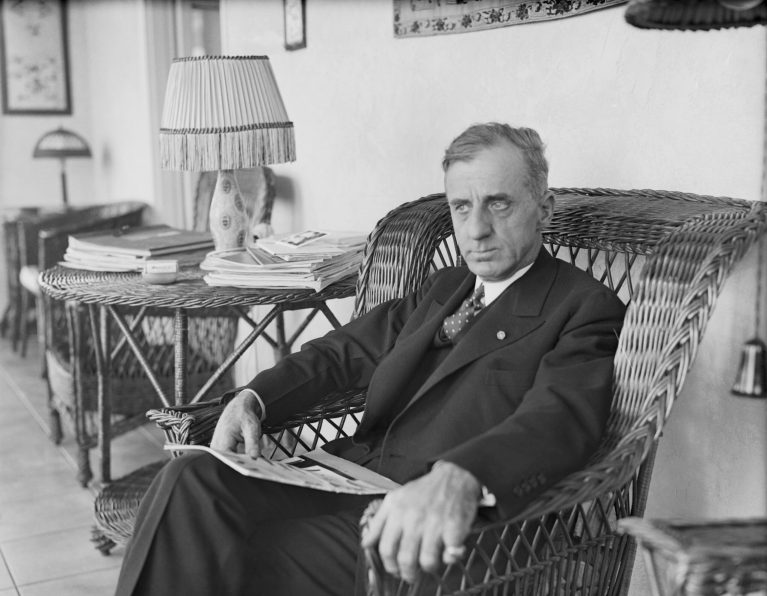
(Original Caption) Frederick, MD.: Maj. Gen. John A. Lejeune, head of the Marine Corps, calls on Gen. Butler in camp at Frederick, Md.

It’s understandable for those of us who were taught in history classes that America is not an imperialist country to be taken aback by the book’s title mentioning empire.  I once thought the same. But as Katz travels in the footsteps of Butler, from Guantanamo Bay, Cuba to Shanghai, China and back, he illuminates how the Corps had been used in the late 19th and early 20th Centuries to make de facto colonies out of the Philippines, Nicaragua, Panama, Haiti, the Dominican Republic, Puerto Rico, Guam, the Commonwealth of the Northern Marianas, American Samoa and the U.S. Virgin Islands. He also does a masterful job detailing our 1914 invasion of Mexico and the 1900 and 1927 occupations of China.

Smedley Butler was the Gen. Jim Mattis of his day – straight-talking, accomplished, and beloved by his troops. He was known nationally by his many nicknames: “The Fighting Hell-Devil Marine,” “Old Gimlet Eye,” “The Leatherneck’s Friend,” and “The Fighting Quaker.” 

Unlike what one might glean from official U.S. Marine Corps history classes given at boot camp and Quantico’s officer candidate school, however, Katz provides a sober look at Butler. He describes a young man, who at 16 years of age, lied to join the Corps at the start of the Spanish American War, eager to prove his manliness to his Congressman father and doting mother. He describes a young officer who led his entire battalion straight into an ambush and then returned to base burning Filipino houses along the way home. 

(Original Caption) Tientsin, China: Photo shows General Smedley Butler (marked with X), commander of American forces in China, at the edge of the foreign concessions in Tientsin watching the disturbances which marked the exit of the Northern troops and the arrival of Marshall Feng Yu-Msiang’s men. Undated photograph. (Photo by George Rinhart/Corbis via Getty Images)

He tells of how a traveling Japanese tattoo artist gave 2nd Lt. Butler a gigantic Eagle, Globe, and Anchor (the classic Marine Corps signifier) chest tattoo – which immediately got infected, relegating him to 3 days of limited duty – and how soon after, Butler and company found themselves in Northern China attacking the city of Tianjin where Butler got shot in the right thigh. Katz also tells the story of how the Marines looted the city of a lode of silver bullion with an estimated value of $11 million in today’s dollars – which was quickly sold to a J.P. Morgan representative in Shanghai; and how Butler, who turned 19 on that campaign, was promoted to the rank of captain, contracted typhoid fever, and returned to San Francisco as a 98-pound ghost.

Beyond the fascinating and familiar portrait of Butler, Katz also excels at depicting the domestic and international politics of the Banana War era and how the United States government and large corporations worked hand in hand to create a string of U.S. outposts around the world and overthrow indigenous governments for the purposes of seizing land, controlling exports, and enriching shareholders.

From Panama to Honduras, Nicaragua to Haiti, Katz reveals how the Marine Corps was used to provide muscle as Wall Street financial institutions and U.S. corporations imposed their will where they invested – rigging elections, violently stamping out dissent, installing dictators, and training and militarizing police forces to keep them in power. He also details Butler’s navigation as a Northerner and a Quaker through the cultural climate of the Corps, which was led mainly by Southern-born officers inculcated with white supremacist world views. 

One of the book’s most interesting aspects is how Katz shows how U.S. policy and our frequent military interventions in the late 1800s and early 1900s created many of the problems still present in Mexico, Central America, and many Caribbean countries.

Katz also captures the evolution of Butler’s thinking as he left active duty, and how he spent his final decade on Earth working to restrain and dial back the same military forces that he had personally helped unleash upon the world. As fascism engulfed Europe, Butler sought to atone for his past transgressions and engaged in anti-war, anti-imperialist, and anti-fascist efforts. Katz covers Butler’s advocacy in 1932 on the behalf of the impoverisheWorld War I veterans of the Bonus Army before they were driven from Washington, D.C. with tear gas, by tanks, and at bayonet point by Army troops led by Gen. Douglas MacArthur. Katz also tells the story of how Butler was recruited in 1934 by agents of Wall Street financiers to lead 500,000 American Legionnaires in a coup to overthrow the Government of the United States and install a fascist dictatorship. 

He goes on to detail Butler’s 1935 blistering condemnation of corporate greed and war profiteering in his book War is a Racket fully 26 years before President Eisenhower warned of the dangers of the military-industrial complex. In this sense, Butler was a man way ahead of his time. 

Those who served during the invasion and occupation of Iraq or any of the bewildering two decades in Afghanistan will see many parallels of wars sold to the American public based on false information and the minimization of the many strategic failures of senior political and military leaders. Katz’s realism may shock many readers, but they would be well served to join him in pulling back the curtain, tipping over the jugs of institutional Kool-Aid, and taking a long, cold hard look in the proverbial mirror. Like watching a train wreck in slow motion, this is a raw historical perspective that will both fascinate and unsettle."

The wild story of Marine legend Smedley Butler that you won’t hear at boot camp

ABOUT THE AUTHOR:

Joe Plenzler is a communication consultant, leadership coach, and backcountry expert. He joined the Marine Corps and became an infantry officer. During that time he attended the Marine Corps’ Mountain Warfare and Jungle Warfare Schools and the NATO Allied Officer Winter Warfare Course in Norway. He also served in Iraq and Afghanistan and finished his military career as the spokesman, press secretary, and staff group director for the 34th, 35th, and 36th Commandants of the Marine Corps.

Joe holds a B.S. in Architecture from The Ohio State University, a M.A. in Mass Communication and Media Studies from San Diego State University, and Certificates in Organizational Consulting & Change Leadership, Facilitation, and Coaching (currently enrolled) from Georgetown University.


Sunday, April 20, 2025

Medal of Honor Recipient Who Recently Died Spoke Of Our Greatest Enemy


Col. Puckett was the last living Medal of Honor recipient from the Korean War and Passed Away April 9, 2024

Ralph Puckett, Army Ranger legend and Medal of Honor recipient, dies at 97

"TASK AND PURPOSE" By Matt White And David Roza

"He fought Chinese soldiers in the Korean War, North Vietnamese troops in Vietnam, and he fought a long recovery from the wounds he suffered in Korea. But the Army Ranger said America’s greatest battle is not with a foreign adversary, but with itself.

“We have divided ourselves into tribes,” he told reporters on the press call. “Our enemies outside our country are aiding and abetting the dissension within our ranks. They’re watching with satisfaction as they see us destroying ourselves.”

_______________________________________________________________

“While we have many enemies of this country today who want to see us fall, there’s no greater enemy in my opinion than ourselves,” Puckett said during a phone call with reporters on Thursday, the day before he received the Medal of Honor from President Joe Biden. 

The award recognized Puckett’s extraordinary heroism” during a battle near Unsan, Korea, in November 1950. A lieutenant at the time commanding the Eighth Army Ranger Company, which consisted of 51 Army Rangers and nine Korean soldiers, Puckett held off an overwhelming force of Chinese soldiers before eventually being forced to retreat. Having been seriously wounded, he told his soldiers to leave him behind, but was ultimately dragged to safety.

Puckett was awarded a Distinguished Service Cross after the battle and offered a medical discharge, which he refused. Instead, he recovered and went on to receive a second Distinguished Service Cross, two Silver Stars for valor, five Purple Hearts, and two Bronze Star Medals with the “V” device for valor. He fought in Vietnam, retired in 1971, and has since become a living legend and mentor within the Army Ranger community.

“He feared no man, he feared no situation and he feared no enemy,” said retired Army Gen. John Walter Hendrix in the Army’s official profile of Puckett. “Clearly a unique, courageous soldier in combat and even more importantly, in my opinion, Col. Puckett was an ultimate infantry leader.”

The 94-year-old Puckett was praised by both President Biden and South Korea’s President Moon Jae-in during his award ceremony at the White House where Biden called him “a true American hero.” But the day prior, the Ranger had a warning for his fellow Americans.

Puckett pinned some of the blame on lawmakers in Congress, who he said have “put their self-interest ahead of their sworn oath” to protect democracy.

The former soldier did not point fingers at any politicians he felt were responsible for choosing self-interest over oath. However, earlier in the call, Puckett expressed his and his wife Jeannie’s faith in President Biden.

“She [Jeannie] expresses it best, she expresses exactly the way I felt about the President when he spoke to me,” Puckett said when recalling Biden’s call telling him he would receive the Medal of Honor. “’This is a man that’s leading our country. I think I can depend on him. So could you.’”

During the award ceremony, Biden also highlighted Puckett’s role as a commander in the early years after the military was desegregated in 1948.

“In an Army that had only recently been integrated, his team included Black, Latino, and Asian American members,” Biden said. “As my mother would say, ‘God love you, man.’”

When the military was considering opening all combat positions to women in 2015, Puckett looked forward to seeing women meet the Ranger standards, saying “I want to see them do it,” Biden recalled.

Whether these anecdotes reflect Puckett’s political views is unclear. However, the Ranger was vocal in his endorsement of one President in particular: George Washington, who the Ranger called “his favorite American.” Specifically, Puckett referred to the grim frozen days of Valley Forge, where Washington and his men weathered through the snowy forests to emerge ready to fight the British for American independence in the Revolutionary War.

“He was amazing, he never gave up. When things were the toughest, George Washington was there,” Puckett said. “He gave everything that he had to train and to lead his soldiers and to fight for freedom. George Washington is my favorite hero, because of the man that he was, the true soldier and leader that he was, and all he did for our country.”

But it wasn’t just Washington who rallied in Valley Forge that winter of 1777 to 1778. It was the common farmers-turned-soldiers under him. Those soldiers stuck with the general and with the cause through the snow and disease to fight, playing just as big a role as the famous founding fathers did in creating this country, Puckett said. 

Now, we have a responsibility to carry on that tradition. Just as Abraham Lincoln once said “a house divided against itself cannot stand,” so too must we “come together and fight together as a United States of America,” Puckett said.

“Our country was not created to be the States of America, but rather we were named the United States of America,” he said. “It’s my hope that all Americans will come to think about that and adapt that to their own thought process, to their own belief system.

“Our country depends on you, me, what you do every day and how you live,” Puckett added. “Without you, we will not be able to maintain our freedom. It depends on us.”


Tuesday, September 26, 2023

Afghanistan Veteran Awarded Medal of Honor Explains Beating PTSD and Finding Peace and Hope

The author, Florent Groberg, is seen here as an Army lieutenant flying over Afghanistan’s Konar province in 2012. He was awarded a Medal of Honor, the nation’s highest combat valor award, after risking his life to minimize the fallout from a deadly suicide attack. (Photo by Staff Sgt. Alexis Ramos)


"WASHINGTON POST” By Florent Gronberg

“I realized sitting in my own hospital bed, having been injured by a suicide bomber, that no Taliban, no al-Qaeda, and no foreign fighter ever truly scared me.

What frightened me were the demons in my head left behind after that traumatic attack, and their relentless work to destroy my inner spirits and finish me off.”


_____________________________________________________________________

“The longest war in American history turns 16 years old — the anniversary of the first deployment of elite special operators to Afghanistan just weeks after the worst terrorist attack in our nation’s history.

Back then our mission was clear, and the call to war was simple: We were going to take out Osama bin Laden, and shut down al-Qaeda’s safe haven for good.

For most American teenagers, a 16th birthday is a huge milestone, a joyful transition into the independence, freedom and opportunities that come with adulthood. But in war, these milestones operate in reverse. The longer they stretch on, the murkier our mission feels, the greater the sacrifice becomes, and the farther into the distance our original goals fade.
Most Americans, glad to be hitting back after being attacked on 9/11, never imagined how expansive this war would become, how many millions would ultimately deploy to fight it, that bin Laden would prove such an elusive target, or that this conflict would morph from a massive manhunt to an even greater struggle for Afghanistan’s nationhood and soul.
And no one would have believed 2,500 American lives — and even more Afghan allies — would be lost.

Americans look at these questions differently and from many perspectives — across our dining room tables and our political divides. Some think we have been there too long, some that victory is just around the corner. Some think we have a responsibility to put Afghanistan back together, others that we are doing more harm than good.
I’ve been a part of these conversations, and I’ve been one of the many confused about our mission. Until I deployed myself.

On the ground in Afghanistan, walking through the silvery moon dust that layers the mountain ridgelines and among ancient societies who carve their homes out of some of the world’s most unforgiving terrain, this war looks very different.
Instead of hostile barbarians, I found myself among hungry and hopeful people. Instead of hunting a terrorist, we hunted for a nation’s future.

Yes, we fought the Taliban, and we used overwhelming American strength to fight those who engaged us with hostility. But we spent much more time working to improve the living conditions for ordinary Afghans, to clear paths for children to safely go to school, to deliver electricity, clean water and basic human security.

I saw the best of humanity at work in Afghanistan through the sacrifices and bravery of the people we worked alongside.
I also saw the depths of evil. Acts of barbaric cruelty, Afghan against Afghan, and brother against brother. The Taliban are a merciless enemy, happy to kill scores of their own people if it was worth one American life.

What hits hardest from my time in Afghanistan is how many of us came home with wounds — physical and emotional.
I nearly became a statistic, one of the 20 veterans who takes his or her life every single day. But like my time in combat, I relied on my brothers and sisters around me. They never quit on me, they pushed me and guided me. They saved my life once in the mountains of Afghanistan and again in the hospital room of Walter Reed National Military Medical Center.
Today, I work with the Boeing Co. to help veterans and their families land careers where they can use their rare and unique skills. Part of that process involves providing our veterans with the resources they need when they, too, are struggling, physically or emotionally. To me, the continuing legacy of this war resides in every job offered to a veteran, in every family reunited with their service member, and in every opportunity for peace that we create.”

ABOUT THE AUTHOR:

Florent Groberg is a retired Army captain, Medal of Honor recipient and author of “8 Seconds of Courage: A Soldier’s Story from Immigrant to the Medal of Honor,” to be released Nov. 7. He works at Boeing Co. as director of veterans outreach and defense, space and security strategy. On Twitter: @FlorentGroberg


Washington Post Medal of Honor Veteran


Friday, June 28, 2019

Medal of Honor Awardee David Bellavia's Stirring Remarks on His "Team"

David Bellavia (Getty Images) 
                                             
Medal of Honor Award - David Bellavia

As combat veterans, we can say this is one of the most unusual and one of the most humble, yet inspiring,  addresses we have ever heard from a man who has been through warfare Hell. 

His words begin at "28.09" on the video play line above.  

We celebrate not only his award but also his words and we hope America and the world is listening.