Search This Blog

Tuesday, October 01, 2019

How To Increase Civilian Understanding Of Our Military And First Responders


Image: Spencer PlatGetty Images

"MILITARY TIMES” By Kevin M. Schmiegel and Patrick A. Burke


“Addressing the civilian-military/civilian-service divide and ensuring support for our military, first responders, and their families, are critical at this time.

One proven solution to build understanding and increase engagement is the creation of hands-on volunteer opportunities during which civilians can meet our military and first responders in person and learn what they do and what they experience.“
_________________________________________________________________
“For 18 years our nation has been at war. In the face of conflict and adversity at home and abroad, brave Americans have volunteered to serve not only in our armed forces but as first responders in thousands of communities across the country. Between them, more than 4.4 million men and women have taken an oath to uphold and defend the Constitution and pledged to protect the freedoms and securities we enjoy as Americans.
Since 9/11, however, observers have acknowledged a widening gap of “understanding” between the 2.1 million Americans who serve in our all-volunteer military force and the rest of the population. While our nation’s longest war continues and hundreds of thousands of service members still and will continue to deploy each year, a majority of military families feel increasingly isolated from their communities and disconnected from their civilian counterparts.

Americans are also less personally connected to military service than ever before. According to the Department of Defense, the number of young adults with parents who have served in the military has dropped from 40 percent in 1995 to 15 percent today, and less than 1 percent of the U.S. population currently serves in the armed forces, compared with more than 12 percent during World War II.”

Unfortunately, a similar “civilian-service divide” is developing between the general public and the 2.3 million police and firefighters who also serve in harm’s way. In the most recent Bureau of Justice Statistics survey issued last fall, the number of Americans age 16 or older who had contact with the police declined from 26 percent to 21 percent in four years, a drop of more than 9 million people. 

This lack of understanding and positive interaction could also be contributing factors to record-low levels of recruitment for both the military and law enforcement.

Examples of how communities are joining together successfully to share experiences can be seen through recent events in Baltimore on June 1, Philadelphia on July 11, and Nashville on Aug. 17, when hundreds of volunteers stood alongside service families to express gratitude in a tangible way. The battalion chief for the Baltimore County Fire Department said it was “the most incredible thing” he had seen in almost 44 years in fire service. That sentiment was further reinforced by the Baltimore Police Department’s chief of patrol, who pointed out officers “needed the community … to help solve issues.”

Fittingly, a similar large-scale service project took place in New York City on Sept. 5 with the production of more than 10,000 signature Operation Gratitude Care Packages and Care Pouches. During the week of Sept. 11, volunteers will deliver those packages to deployed service members around the world and to first responders who responded to the Pentagon attack 18 years ago. These interpersonal activities will help close the gap between those who serve and those who are served and provide avenues to express mutual respect and appreciation.

With the deaths of 15 service members in Afghanistan and 118 police and firefighter fatalities here at home so far in 2019, communities in our country yearn for opportunities to recognize and thank all who serve in uniform. Hands-on volunteerism is the most effective way for American citizens to engage with our military and first responders, forge strong bonds and build sustainable relationships that ultimately will strengthen their communities, as well as strengthen the resolve of the brave men and women who serve and protect them.”


ABOUT THE AUTHORS:

Kevin M. Schmiegel is a retired Marine Corps lieutenant colonel who now serves as the chief executive officer of Operation Gratitude, a national 501c3 nonprofit.

The Honorable Patrick A. Burke is the former United States marshal and assistant chief of police for the District of Columbia, and now serves as the executive director of the Washington D.C. Police Foundation

 e Images

Sunday, September 01, 2019

GAO Says More Veterans Heading For Veterans Homes That May Not Be Ready

Image: “Columbiacare.org“

“MILITARY.COM“
“The report, released Aug. 2, found the number of veterans in VA funded nursing home care is expected to total about 44,000 by 2022.
Challenges in contracting with community nursing homes (CNHs), which provide the bulk of that care, could keep the agency from being able to meet demands."
_______________________________________________________________________
“Although the number of veterans in nursing homes is expected to rise 16% between 2017 and 2022 as veterans who served in Vietnam continue to age, the VA may not be prepared to handle the increase, according to a new report from the Government Accountability Office.
And while some of those issues may be helped by a recent VA healthcare law, known as the Mission Act, concerns remain, auditors wrote.
“While VA expects to continue placing more of the veterans needing nursing home care into CNHs, officials noted some challenges contracting with these homes,” the GAO report states. “Specifically, VA central office officials said that about 600 CNHs had decided to end their contracts with VA over the last few years for a variety of reasons. For example, officials from four of the [VA Medical Centers] we interviewed told us about CNH concerns that contract approvals can take two years, homes have difficulties meeting VA staff requirements, and VA’s payment rates were very low.”
In addition, the homes may not be able to handle the special needs some elderly veterans face, including behavioral issues or dementia, the study found.
“[VA officials] said homes may not have any of the necessary specialized equipment or trained staff, or may not have as many of these beds as needed, to meet certain veterans’ special care needs,” the report said. “VA officials told us that they are working to expand the availability of special needs care in each of the three setting.”
The VA covers the full or partial cost of nursing home care for veterans, depending on availability and the veteran’s disability rating or injuries. Veterans rated at 70 percent or higher for service-connected disabilities or those who are receiving nursing home care as the result of a service-connected disability are fully covered.
The system provides care in three types of homes. CNHs are publicly or privately owned and operated and contracted with the VA. State veterans homes are typically owned and operated under the preview of the state in which they are located. And community living centers, which often provide acute care, are owned and operated by the VA and associated with the local VA hospital.
Auditors found the VA should do a better job monitoring the quality and performance of nursing homes, an improvement that will be increasingly important as the number of veterans using the facilities increases.
VA officials contract out inspections of nursing homes, but do not regularly monitor contractors’ performance to determine whether or not inspections are being done correctly, the report said. And the way the system works with state veteran homes does not flag all quality problems, which keeps the system from tracking them.
Moreover, VA officials haven’t given VA hospital staff instructions on how to conduct on-site reviews of nursing homes without the contractor, which means they can’t hold those facilities accountable for correcting problems, the report said.
“By making enhancements to its oversight of inspections across all three settings, VA would have greater assurance that the inspections are effective in ensuring the quality of care within each setting,” the report said.
The report also recommended that VA clarify its communication on the types of nursing home care are available, giving more information on state veterans homes and how their quality compares to the other options.
VA officials generally concurred with all four recommendations. They said they plan to act on the report’s recommendation to increase oversight of inspectors while changing how issues with state veteran homes are flagged. They argued, however, that their employees don’t have the authority or oversight to inspect community nursing homes directly. They also said they would investigate whether or not it’s feasible to provide data on state veteran home quality.”

Thursday, July 11, 2019

Two Decades of War Have Eroded the Morale of America’s Troops

Image:  USO - Hampton Roads and Central Virginia

"THE ATLANTIC"

"The military can’t set its own goals, can’t determine its own budget or which ideals it fights and dies for, and can’t decide how its losses will be honored, dishonored, or appropriated after the fact. 

So while America as a whole chooses to express its love for its military in gooey, substance-free displays, our military waits, perhaps hopelessly, for a coherent national policy that takes the country’s wars seriously."

________________________________________________

"If the courage of young men and women in battle truly does depend on the nature and quality of our civic society, we should be very worried. We should expect to see a sickness spreading from our public life and into the hearts of the men and women who continue to risk their lives on behalf of a distracted nation. 

And when we look closely, that is exactly what we see: a sickness that all the ritualistic displays of support for our troops at sporting events and Veterans Day celebrations, and in the halls of Congress, can’t cure.

Our military is a major part of who we are as a country; it is the force that has undergirded the post–World War II international order. Being an American means being deeply implicated in that, for good or for ill. But as Wellman’s response to his war suggests, the solution to our current dead end doesn’t lie within the military itself. 

The military can’t set its own goals, can’t determine its own budget or which ideals it fights and dies for, and can’t decide how its losses will be honored, dishonored, or appropriated after the fact. So while America as a whole chooses to express its love for its military in gooey, substance-free displays, our military waits, perhaps hopelessly, for a coherent national policy that takes the country’s wars seriously.

What would such a thing look like?

It would probably look like rescinding the open-ended Authorization for the Use of Military Force and making the president regularly go before Congress to explain where and why he was putting troops in harm’s way, what resources the mission required, and what the terms of success were. 

It would look like every member of Congress carrying out his or her constitutionally mandated duty to provide oversight of our military adventures by debating and then voting on that plan. 

It would look like average Americans taking part in that debate, and scorning anyone who tried to tell them they couldn’t. It would look like average Americans rolling their eyes in disgust when our leaders tell us we’re not at war while American troops are risking their lives overseas, or claim that Americans must support the wars their country engages in if they want to support the troops, or when a press secretary argues that anyone who questions the success of a military raid in which a service member died “owes an apology” to that fallen soldier. 

It would look like our politicians letting the fallen rest in peace, rather than propping up their corpses for political cover. And when service members die overseas in unexpected places, such as the four killed in Niger last year, it would look like us eschewing the easy symbolic debates about whether our president is disrespecting our troops by inartfully offering condolences or whether liberals are disrespecting our troops by seizing upon those inartful condolences for political gain. It would look like us instead having a longer and harder conversation about the mission we are asking soldiers to perform, and whether we are doing them the honor of making sure it’s achievable.

In short, it would look like Americans as a whole doling out a lot fewer cheap, sentimental displays of love for our troops, and doubling down on something closer to Gunny Maxwell’s “tough love”—a love that means zeroing in on our country’s faults and failures.

if we don’t, then at some point the bottom will drop out. Morale is a hard thing to measure, but plenty of indicators suggest that it’s been falling. Ninety-one percent of troops called their quality of life good or excellent in a survey done by the Military Times back in 2009, when the downturn in violence in Iraq and a new strategy in Afghanistan still held out a promise of victory; by 2014 that had fallen to only 56 percent, with intentions to reenlist dropping from 72 to 63 percent. 

Recruiting is also down. For the past three decades, the military has generally accepted about 60 percent of applicants. In recent years that figure has been closer to 70 percent and is climbing. And the active-duty force is getting worn out. When I was in, I was impressed to meet guys with five deployments under their belts. Now I meet guys who have done eight, or nine, or 10. 

The situation is particularly bad within the Special Operations community. Last year Special Operations Command deployed troops to 149 countries; some operators cycled in and out of deployments at what General Raymond Thomas called the “unsustainable” pace of six months overseas, six months at home. I recently met an Army ranger who’d done seven deployments. He was on a stateside duty, and told me that when he and his wife realized that he’d be home for two years straight, it freaked them out a bit. They loved each other, and had three kids, but had never spent two solid years together without one of them going on a deployment. This is too much to ask, especially for ongoing wars with no end in sight. 

Theresa Whelan, the principal deputy assistant secretary of defense for homeland defense and global security, recently told the House Armed Services Committee that the Special Operations community has “had to eat our young … [and] mortgaged our future” to keep going.

Day by day, that mortgaged future creeps closer. When it arrives, who is going to sign up for a vague and hopeless mission? How do you motivate men and women to fight and die for a cause many of them don’t believe in, and whose purpose they can’t articulate? What happens to the bonds between men and women in combat, and to the bonds between soldiers and the citizenry for whom they fight, when we fail as a nation to treat our wars as a collective responsibility, rather than the special mission of a self-selected few?

Without a political leadership that articulates and argues for a mission and objective worth dying for, it’s no surprise that soldiers sometimes stop caring about the mission altogether. A sergeant who deployed to the Korengal Valley, in Afghanistan, told me that by the end of his deployment, he had purposely adopted a defensive posture, sacrificing mission for safety at every opportunity he could. 

This is reminiscent of what one officer said of the later stages of the Vietnam War: “The gung-ho attitude that made our soldiers so effective in 1966, ’67, was replaced by the will to survive.” It’s not that those troops lacked courage, but that the ends shifted. “We fought for each other,” I’ve heard plenty of veterans claim about their time in service, and no wonder. 

If your country won’t even resource the wars with what its own generals say is necessary for long-term success, what else is there to fight for? But if you think the mission your country keeps sending you on is pointless or impossible and that you’re only deploying to protect your brothers and sisters in arms from danger, then it’s not the Taliban or al-Qaeda or isis that’s trying to kill you, it’s America."


Friday, June 28, 2019

Medal of Honor Awardee David Bellavia's Stirring Remarks on His "Team"

David Bellavia (Getty Images) 
                                             
Medal of Honor Award - David Bellavia

As combat veterans, we can say this is one of the most unusual and one of the most humble, yet inspiring,  addresses we have ever heard from a man who has been through warfare Hell. 

His words begin at "28.09" on the video play line above.  

We celebrate not only his award but also his words and we hope America and the world is listening.  


Sole Source Contractor With Non-Competitive $16 Billion VA Records Integration Contract Calls It “Immense Challenge”

Image: FCW.com

Editors Note:  Cerner was determined to be the sole source for this requirement because they are running the current system for the Military and after billions in historical failures to connect the VA records system to the military, the military and the VA jointly decided to move the entire VA records system over from its current hosting to the military software.  This company thus became the sole source and competition was waived.  For further details please see:   https://rosecoveredglasses.blogspot.com/2018/06/the-next-10-billion-tax-payer-chapter.html
________________________________________________________________________
MILITARY.COM“
“This won’t be easy,” the prime contractor said of the $16 billion effort to overcome decades of failure and finally make veteran and military health records compatible with a few computer clicks.
We must deploy to 117 sites, train over 300,000 VA employees, collaborate with DoD, interoperate with the community, aggregate decades of clinical data and update technology,” he told a hearing of the House Veterans Subcommittee on Technology. “
“It carries risk, and we don’t take the challenges lightly” in implementing Electronic Health Record Modernization (EHRM) programs across the Departments of Veterans Affairs and Defense”, said Travis Dalton, president of government services for Cerner Corp. of Kansas City.
In addition, the new system will have to link with additional community health care providers expected to come onboard with the June 6 rollout of the VA Mission Act, which will expand private health care options for veterans, said Rep. Jim Banks, R-Indiana, the ranking member of the subcommittee.
“Interoperability with the community providers is still the elephant in the room,” he said.
About 30% of veterans currently get health care at taxpayer expense in the private sector, and they “rightfully expect their records to follow them,” Banks said. He said his main concern is that a “half-baked system” will be rushed into use.
Rep. Susie Lee, D-Nevada, chairwoman of the subcommittee, said that Cerner and partners Leidos and Booz Allen Hamilton are attempting to create “one seamless lifetime record for our service members as they transition from military to veteran status,” but “this effort also has the potential to fail.”
“The VA unfortunately does not have a great track record when it comes to implementing information technology,” she said, “and it threatens EHRM.”
Previous attempts to mesh VA and DoD records have either failed or been abandoned, most recently in 2013 when then-Defense Secretary Leon Panetta and then-VA Secretary Eric Shinseki dropped an integration plan after a four-year effort and the expenditure of about $1 billion.
“This won’t be easy, but it is achievable and we are making progress” in the overall effort to let “providers have access to records wherever they deliver care,” Dalton said.
Jon Scholl, president of the Leidos Health Group and a Navy veteran, said the example to follow is the MHS Genesis system, the new electronic health record for the Military Health System. “MHS Genesis is the solution,” he said at the hearing.
However, Lee said that “a suitable single management structure has yet to emerge” for EHRM since then-Acting VA Secretary Robert Wilkie awarded a $10 billion, 10-year contract to Cerner in May 2018. The cost estimate for the contract has since risen to $16 billion.
At a hearing last month of the House Defense Appropriations Subcommittee, Acting Defense Secretary Patrick Shanahan was challenged on the DoD’s efforts to work with the VA on EHRM.
“I don’t ever recall being as outraged about an issue than I am about the electronic health record program,” Rep. Kay Granger, R-Texas, told him.
“Personally, I spend quite a bit of time on how do we merge together” with the VA on the records, Shanahan assured her.
He said pilot programs on making the records compatible are underway in Washington state at Joint Base Lewis-McChord, Naval Base Kitsap, Naval Air Station Whidbey Island and Fairchild Air Force Base.
The “rollout and implementation” of the fix to the electronic health records has shown promise at those installations, Shanahan said, adding that the next step is to put the programs in place at California installations in the fall.”

Monday, May 27, 2019

Memorial Day 2019 - A Combat Vet Talks "Cause and Effect"

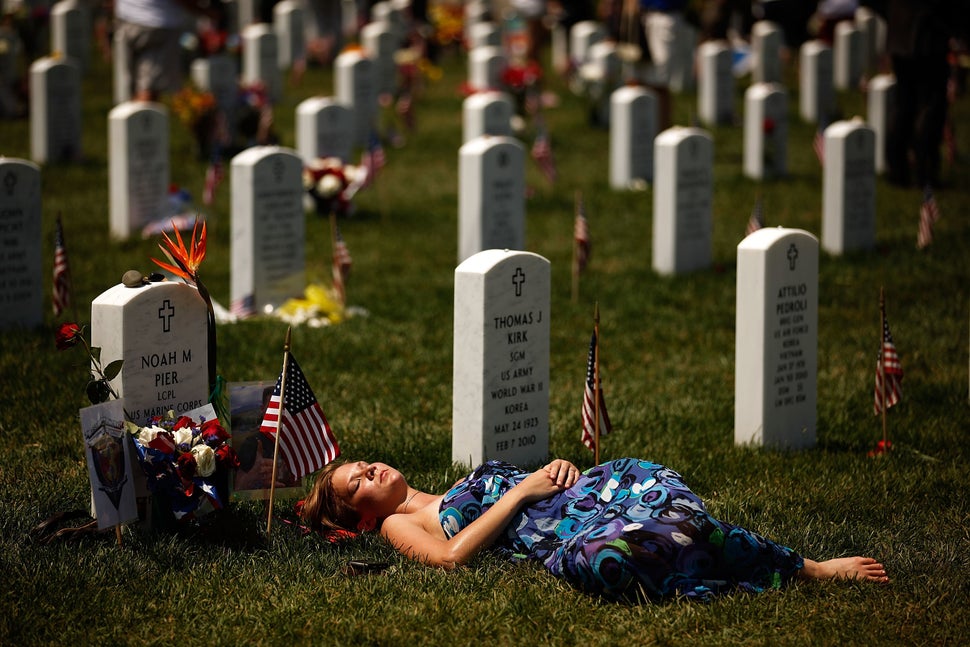
A young woman lays down on the grave of U.S. Marine Corps Lance Corporal Noah Pier on Memorial Day at Arlington National Ceme
A young woman lays down on the grave of U.S. Marine Corps Lance Corporal Noah Pier on Memorial Day at Arlington National Cemetery on May 31, 2010, in Arlington, Virginia.  (Chip Somodevilla via Getty Images)

As we honor our fallen this Memorial Day, an observer of our military actions over the last two decades in the Middle East could in no way have predicted the splintered, irrational, “Turn-Your-Back-And-You-Have-Two-New-Enemies”, scenario the US faces today. Perhaps a look back over our shoulder, examining cause and effect relationships along the road is in order.

CAUSE:  The US fights a just and honorable war assisting many Middle East allies and other countries free Kuwait.

EFFECT:  Saddam Hussein is driven from Kuwait and the country is returned to its rightful government.

CAUSE:  The US does not leave the Middle East after rescuing Kuwait, but rather, stays in peripheral countries militarily “To Protect Our Interests” with an imperialist attitude resented by cultures that have an ingrained,religious hatred for that type of presence by foreigners.

EFFECT:  The rise of Bin Laden and many more like him today and the deaths of 3,000 Americans on our soil, attacked in our homeland because we did not leave the Middle East. 

CAUSE:  The US reacts to 911 by setting up an elaborate Homeland Security apparatus and beefing up the National Security Agency by orders of magnitude, technologically, while putting in place a carefully concealed legal apparatus to counter terrorism.

EFFECT: The US has no outside terrorist incidents of a 911 magnitude since the Twin Towers fell in 2001 but Americans develop real concerns about our government and its role in controlling our lives as whistle blower disclosures regarding the apparatus of intelligence operation reveal potential constitutional issues.

CAUSE:  The US invades Iraq fed by false, intentionally staged intelligence, fronted by agencies and industries bent on economic gain. The US sets about war fighting and nation building programs that seek to displace a culture that had evolved through conflict and war lords for hundreds of years and is tied to the absolute requirement that religious practices be part and parcel of government, a principle the US has rejected as unworkable since our Constitution was written

EFFECT:  Failure to build anything substantial in the form of a nation over a 17 year period.  The deaths or crippling of our finest soldiers, dramatic increases in our national debt and a cynicism among our citizens with respect to the $Billions that have gone into the pockets of corporations supporting our huge Military Industrial Complex (MIC) and wasteful USAID Programs by companies that spend more lobbying Congress than they pay in taxes.

CAUSE:  The present Middle East unrest due to ISIS/ISIL and other splinter groups we thought had been scattered to the winds. 

EFFECT:  UN security council meets with many nations talking and less than a half dozen nations carefully and selectively participating in an air war against terrorism while the remainder watch the outcome.   Our military and corporate defense establishment (MIC) shout, “Sequestration to reduce military spending must end!” and estimates more years will be required with more American boots on the ground to train forces that we had already trained for a decade and provide "Stability"). 

CAUSE (PROJECTED):  A political battle like none seen in recent times during the coming US national  elections, driven by concerned American citizens and their view of the US role in the Middle East. As our burgeoning National Debt Clock approaches $23 Trillion the culture in that part of the world has had a very difficult time figuring out how we can help while we near energy independence from oil and require some nation building of our own in the homeland. 

EFFECT (PROJECTED): A leader and a political climate that will permit prudence, tough decisions, carefully avoidance of bad intelligence and overreaction so that we do not continue to sink into the oil and blood soaked desert of Middle East cultural revolutions. 

Global corporations will then cease consuming the MIC and USAID tax payer dollars to prosper, while parking their assets overseas as our young become indebted for generations.


Image: usf.edu/florida